


Zones of Regulation
Zones of Regulation
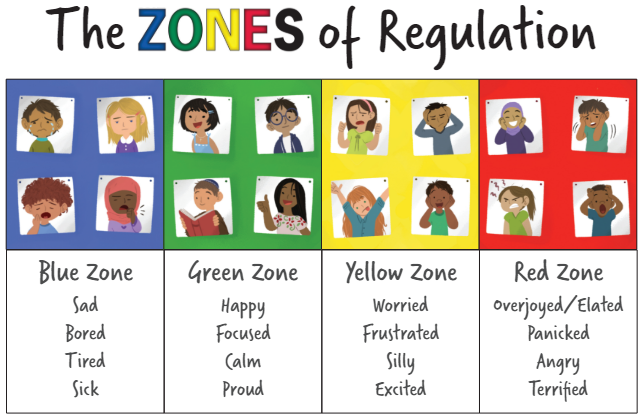
At Mereworth Community Primary School
The Zones of Regulation were officially launched in April 2024 and are best described as a curriculum framework used to teach children self-regulation and self-control.
Self-regulation is defined as being the ‘best state of alertness’ for a situation, or the ability to maintain a well-regulated emotional state to cope with everyday stresses. From time to time, all of us (including adults) find it hard to manage strong feelings such as worry, anger, restlessness, fear or tiredness, and this stops us from getting on with our day effectively. Anyone who feels these emotions can find it hard to learn, concentrate, or interact with others effectively.
At Mereworth Community Primary School, we want to teach all of our children strategies so that they can help themselves when they experience intense emotions both now, and as they continue their journey into secondary school and beyond.
The Zones of Regulation aims to teach children strategies to help them to identify their emotions and cope with these feelings, or seek help from adults, so that they can get back to feeling calm and ready to learn.
The Zones of Regulation categorises states of alertness and emotions into four coloured zones: blue, green, yellow and red. Please see definitions and descriptions below:
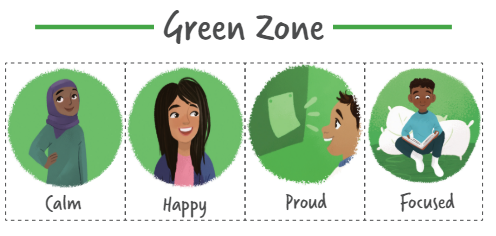
Green Zone
The Green Zone is used to describe a regulated state of alertness. A person might be described as calm, happy, focused or content when in the Green Zone. This is the zone children generally need to be in for schoolwork and for being social. Being here shows control. Think about what you can do to maintain this state:
- Activities that calm you such as meditation, paying attention to the environment you are in (so it is not too loud, crowded, bright etc), access to resources.
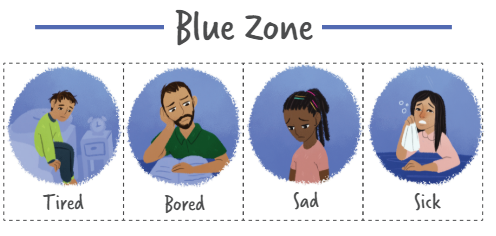
Blue Zone
The Blue Zone is used to describe low states of alertness such as when one feels sad, tired, sick, or bored. This is when your body and or brain is moving slowly or sluggishly. When you are in the Blue Zone, you can:
- Think about what you can do when you are sad, tired, or bored. This might be talking to a friend or trusted adult, doing some breathing exercises, enjoying a hobby or activity, relaxing somewhere quiet, or some physical exercise.
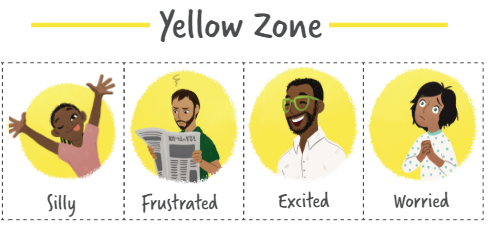
Yellow Zone
The Yellow Zone is also used to describe a heightened state of alertness; however a person has some control when in the Yellow Zone. A person might be experiencing stress, frustration, anxiety, excitement, silliness, nervousness, confusion, and many more slightly elevated emotions and states when in the Yellow Zone (such as wiggly, squirmy, or sensory seeking). The Yellow Zone is starting to lose some control. When we start to lose control we may:
- Become physically agitated, uncomfortable, over-excited, unfocused, uneasy.
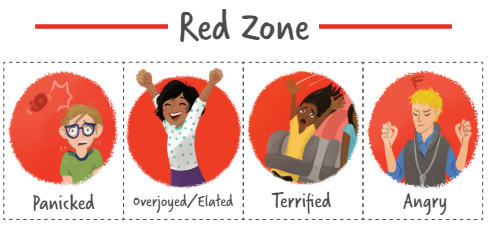
Red Zone
The Red Zone is used to describe extremely heightened states of alertness or very intense feelings. A person might be experiencing anger, rage, explosive behaviour, panic, terror, or elation when in the Red Zone. Being in the Red Zone can best be explained by not being in control of one’s body. When this happens, we might:
- Need to be removed from the setting or situation
- Need help accessing strategies to help us calm down
- Try “powering down” overwhelming emotions by: deep breathing, deep pressure, sensory activities, quiet time, etc.
- Need more concise, calm, and minimised communication.
At points of the day when children can potentially feel unregulated (such as entering school, after break or lunch) adults will facilitate a “Zones Register”, where children share the Zone they believe they are in, by moving their own photograph onto the colour Zone that best represents their emotional state at that time.
There is no bad zone, but it is important to learn and use strategies that help each child to be in the Green Zone. Therefore, when a child indicates that they are not in the Green Zone, an adult will have a conversation with the child to help identify feelings accurately, and assist with strategies that might help to re-establish regulation. Similarly, we often see children indicate that they are in the Green Zone when an adult can see that they are not. Again, at the time, an adult would offer time and space to explore any behaviours that the child might be showing.
It is important to know that it is fine for children to experience all emotions whilst they are at school and equally important to validate all emotions.
The children can move their pictures at any point during the day, which allows staff to see who is experiencing more intense emotions at any point.
Over time, children will learn increasing and more complex strategies that they can use should they need to. By introducing the Zones of Regulation, our aim is for children to learn more about the feelings of themselves and others and feel empowered to self-regulate, resulting in increased self-esteem and wellbeing.
At other points throughout the day when a child is displaying unexpected behaviour, the adult with them will discuss the Zones of Regulation to support them in managing their own feelings and their behaviour.
Step 1 – Recognising the Zone you are in
Step 2 – Choosing a strategy to move you back to the Green Zone
Step 3 – Reflect on the Zone you are in
Step 4 – Create a plan for when we next need to move through the Zones
How can you help your child use the Zones of Regulation at home?
- Model and identify your own feelings using Zones language in front of your child e.g. I’m frustrated I think I’m in the Yellow Zone.
- Observe your child’s behaviour and try to use strategies when they are showing signs of being in the Yellow Zone to catch it before they move into the Red Zone.
- Discuss which Zone your child is in. Discuss what Zone a character in a book or film might be in e.g. You look sleepy, are you in the Blue Zone?
- Praise and encourage your child when they share which Zone they are in.
- Have easy access to calming/sensory equipment at home.
- Monitor your language – less is best and minimal in the Red Zone.
- Share how their behaviour is affecting your Zone, for example if they are in the Green Zone you can say that their behaviour is also making you happy/making you go into the Green Zone too.
Tips for helping your child to regulate
- Know your child’s sensory threshold – we are all different.
- Know their triggers – what can upset them might not upset you, and vice versa.
- Be consistent in managing their behaviour.
- Have clear boundaries and routines and always follow through.
- Do not deal with an angry or upset child when you are not calm yourself.
- Remember to ask your child how their choices made you feel to help develop empathy.
- Praise your child for using strategies and encourage them to take sensory breaks to regulate their bodies.
Find out more about the Zones of Regulation at the following websites: